

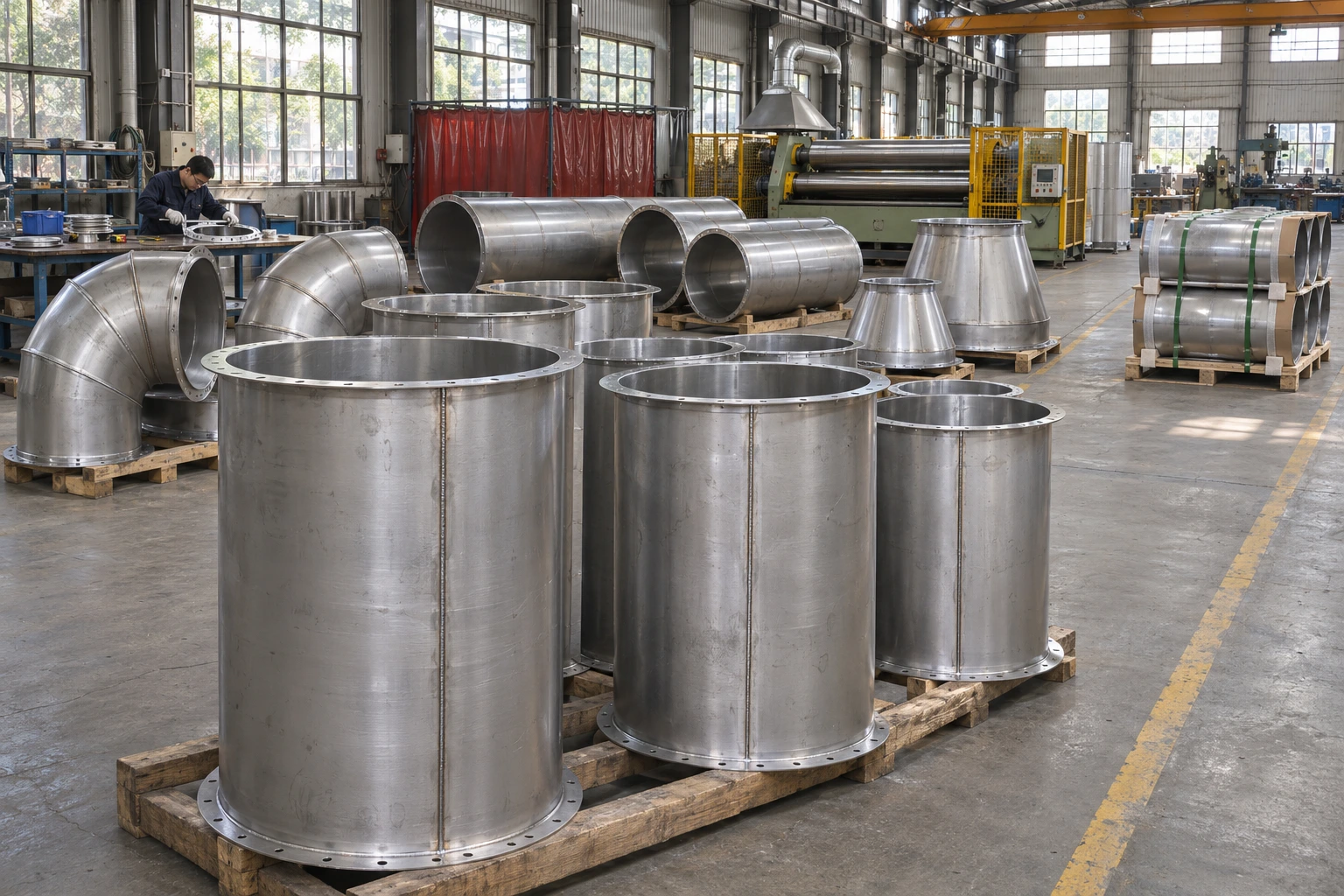
 When inquiring about welded air ducts, a common communication difficulty is that "make it according to the conventional thickness" without a clear corresponding design basis. Different systems may transport room-temperature air, dusty gas, hot and humid gas, or corrosive media. The working conditions and maintenance methods are different, and the materials and plate thickness cannot be simply applied based on the outer diameter or cross-sectional size. Complete the working conditions and acceptance requirements before purchasing, so that the processor, designer and installer can price based on the same caliber.
Let’s first explain the transport medium and operating environment.
List the media composition, temperature range, whether it contains moisture or particles, whether it may contain corrosives, and whether the pipe is located indoors, outdoors, or in a wet area. If the medium will change with the process, normal and possible working conditions should be explained. Material selection should consider corrosion resistance, welding suitability, cleaning requirements and subsequent maintenance; "corrosion resistance" cannot only be used as a procurement description, the material grade should be clearly defined or the scope should be given by the design document.
Pressure, size and support combine to influence structural requirements
Confirm the system's positive or negative pressure, operating fluctuations, pipe diameter or section size, pipe section length, reinforcement form, and support spacing. Large pipe sections, even if made of the same material, may behave differently due to differences in panel spans and reinforcement schemes. Structural parameters such as plate thickness, stiffeners, angle steel or flanges should be checked as a whole according to the design requirements. Thickening the plate should not be regarded as the only way to solve all deformation or vibration problems.
Write the connection and post-welding treatment together into the technical conditions
The inquiry document also needs to describe the weld joint form, flange construction, sealing requirements, post-weld grinding or surface treatment, and whether specific inspection records are required. For stainless steel or systems with hygienic cleaning requirements, surface condition and cross-contamination protection may also affect material selection and workmanship. If there is insulation, cladding, grounding or protective coating, it should be stated which party supplies and constructs it, so as to avoid only checking the pipe body material and missing the supporting equipment.
Lock in a unified plate thickness and caliber when comparing quotations
Before comparing different quotations, confirm the material, nominal thickness and allowable deviation, pipe section size, reinforcement, flange, elbow tee and inspection opening and other quantity and caliber item by item. The list indicates the drawing version, unit, interface size and special working conditions, and clearly states the confirmation process for design changes. In this way, it can be seen whether the price difference comes from materials, structures, accessories or scope of supply, so as to avoid adding necessary items only when the low-price plan is deepened or accepted.
The actual plate thickness and structural parameters need to be determined by the designer based on system conditions and applicable standards. The inspection ideas in the article are used to organize procurement information and cannot replace engineering calculations or project approvals; technical documents, quotation lists, and acceptance terms should be consistent with each other before placing an order.