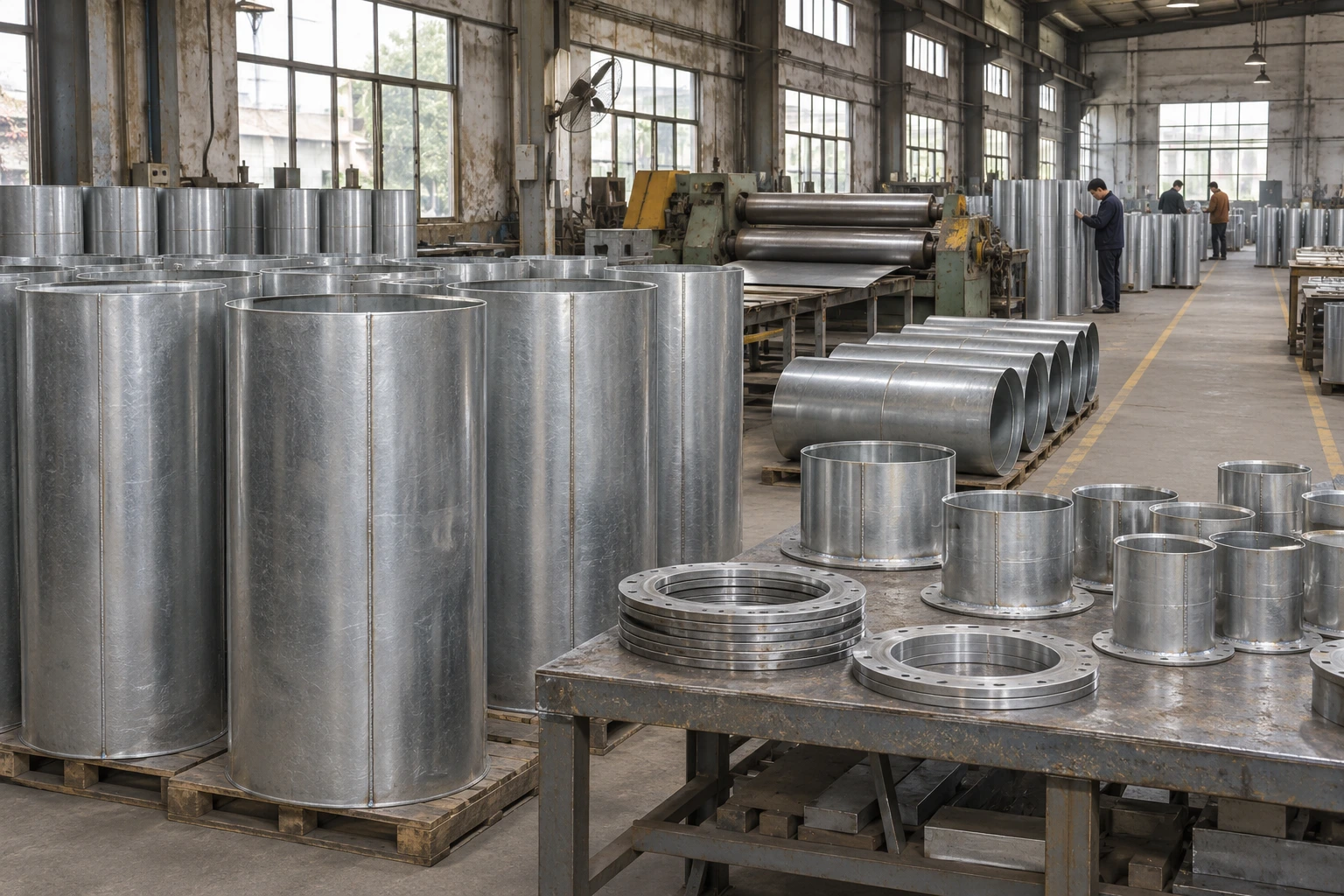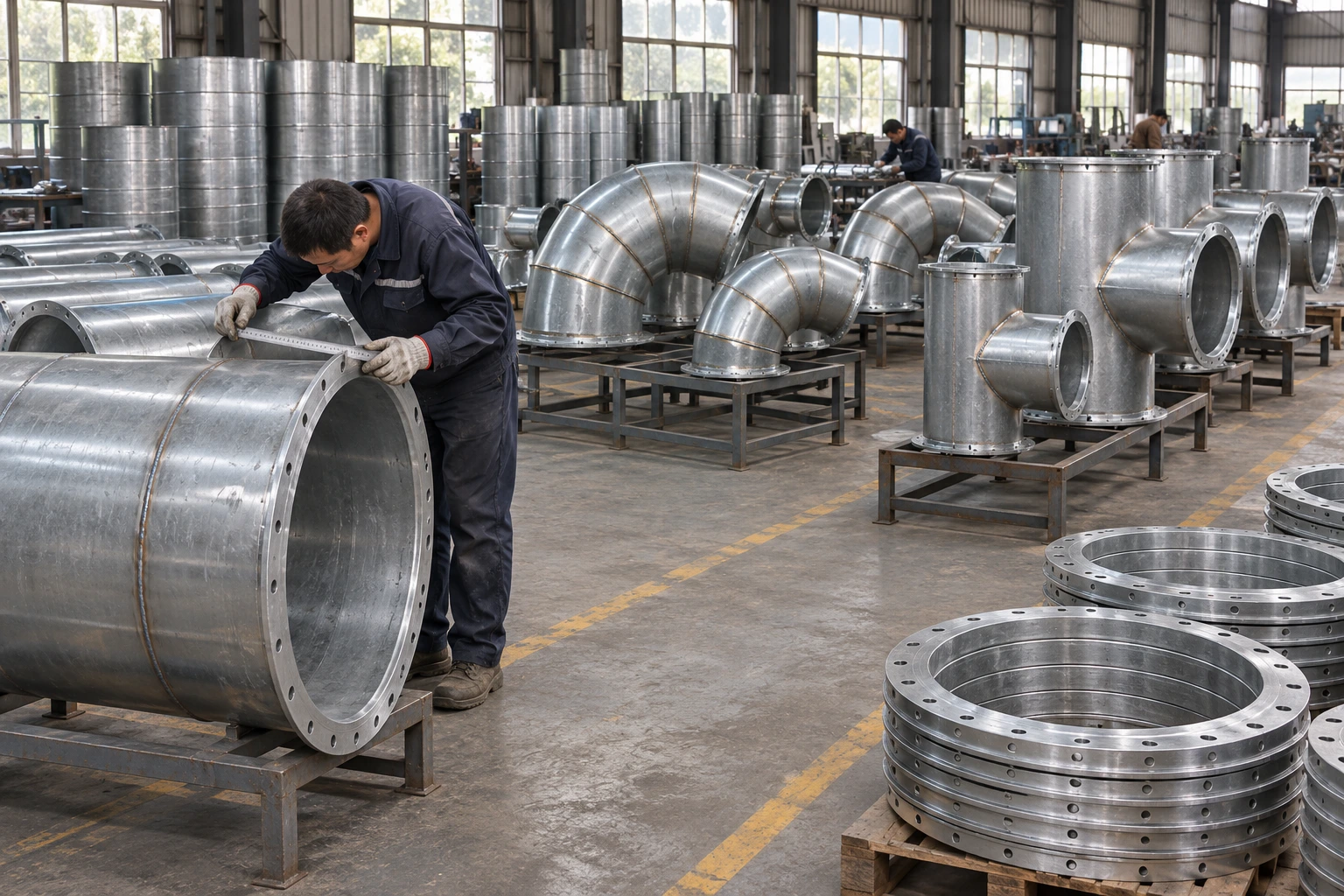

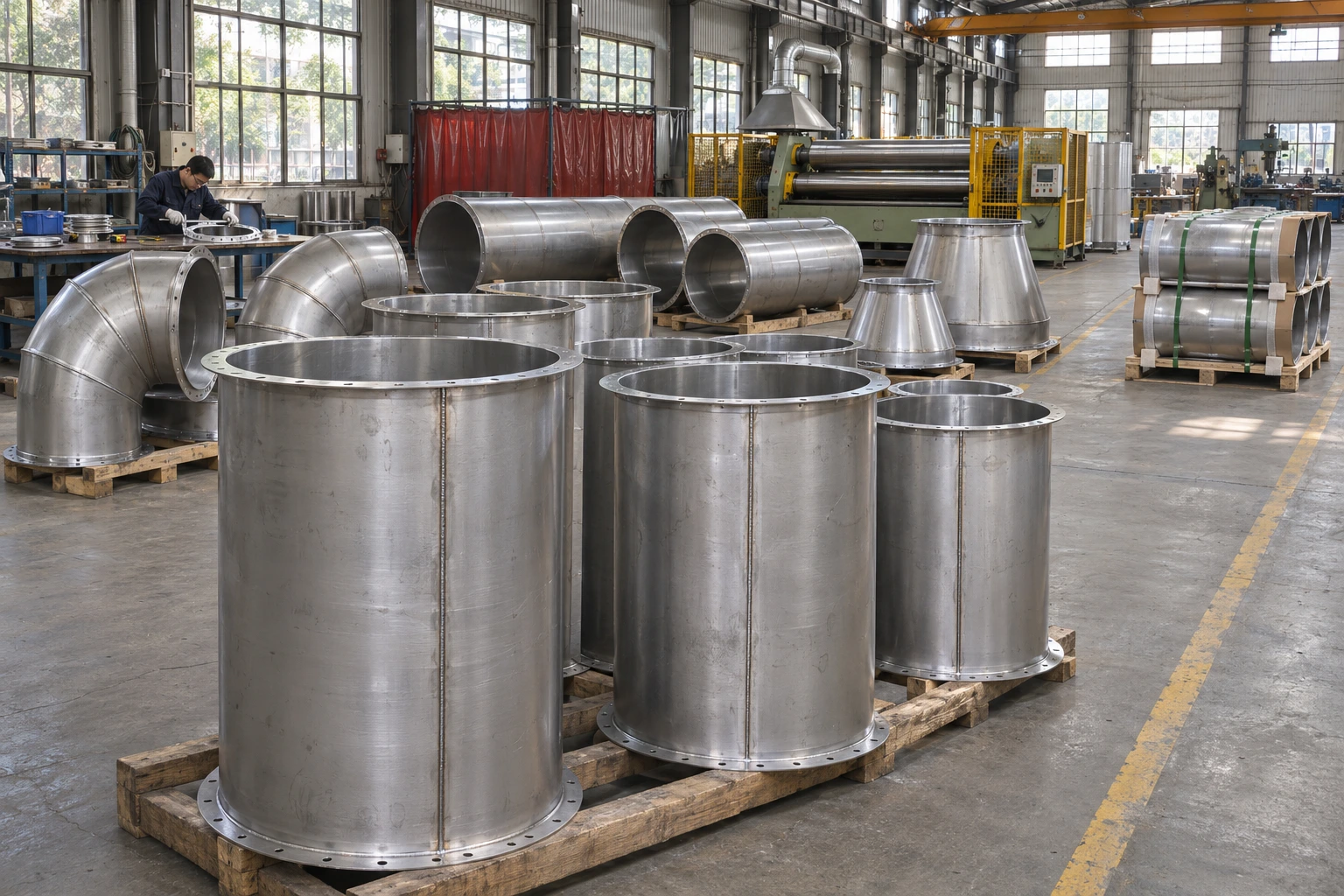
A common challenge when installing circular welded ducts in projects in Zhongshan is that ducts with the same specified diameter on the drawings may not fit together properly on-site. This can be due to differences in measurement reference points, flange hole alignments, connection orientations, or discrepancies between equipment specifications and the fabrication list (e.g., using different versions of documents). To resolve such issues, first verify the requirements for both ends of the connection, then determine the fabrication plan; this prevents leaving all discrepancies to be addressed during on-site installation.
First, establish a unified standard for measuring duct diameters and lengths.
When confirming dimensions, do not rely on a single figure. For circular duct sections, specify exactly which dimension is being referenced—clarify whether the length includes flanges or other connection components—and mark the measurement points on the drawings. Ensure that adjacent duct sections, equipment interfaces, and transition pieces share consistent reference points. If on-site measurements are used, record the date and location for each; for unverified data, note the source to prevent estimated values from being mistakenly treated as final fabrication dimensions.
II. Verify the complete connection configuration for all flanges.
Do not match flanges based solely on visual similarity. Refer to the approved drawings to verify connection interfaces, bolt-hole patterns, orientation, and the requirements for fasteners—including which party is responsible for supplying them. For pipe segments that include elbows, branch pipes, or offset connections, clearly mark the installation orientation to prevent discrepancies in the overall assembly, even if individual components are dimensionally correct. Any requirements for sealing materials or specialized connection methods must be explicitly defined in the project documentation.
III. Verify welding requirements and connection dimensions separately.
The longitudinal seams of welded air ducts and their end connections require distinct verification processes. Requirements for welds, materials, surface treatments, and the scope of inspection should be agreed upon before placing an order; meanwhile, connection dimensions must be matched individually against the corresponding equipment or adjacent duct segments. A neat-looking weld does not justify skipping the verification of connection dimensions, nor should visual inspection be considered the sole method for final acceptance. Specific testing methods and acceptance criteria shall be governed by the design documents and project-specific agreements.
IV. Prioritize trial-fitting for non-standard connecting segments
Equipment connection segments are often constrained by equipment positioning, piping routing, and on-site space limitations. Before procurement, gather all relevant documentation—including equipment interface drawings, installation positioning data, and information regarding surrounding obstacles. For critical non-standard components, clarify whether samples, templates, or trial-fitting procedures are required. Any proposal to alter piping layouts or equipment connection methods must be formally approved by the relevant project stakeholders. Do not modify established structural or connection requirements for the sake of temporary convenience during installation without obtaining proper authorization.
V. Utilize numbering and version control to minimize rework.
Ensure that the finalized drawings, pipe section identification numbers, interface schedules, and accessory lists are all cross-referenced and aligned. In the event of a change, clearly specify which pipe sections require adjustment, confirm that the previous version is no longer in use, and outline how any already-fabricated components should be handled. Upon delivery, verify quantities, connection dimensions, and the physical condition of the items; document any anomalies. When requesting a quote from Foshan Jinyou Environmental Protection Equipment Co., Ltd., providing confirmed interface specifications and the defined scope of supply—rather than just pipe diameters and quantities—will facilitate more accurate communication.