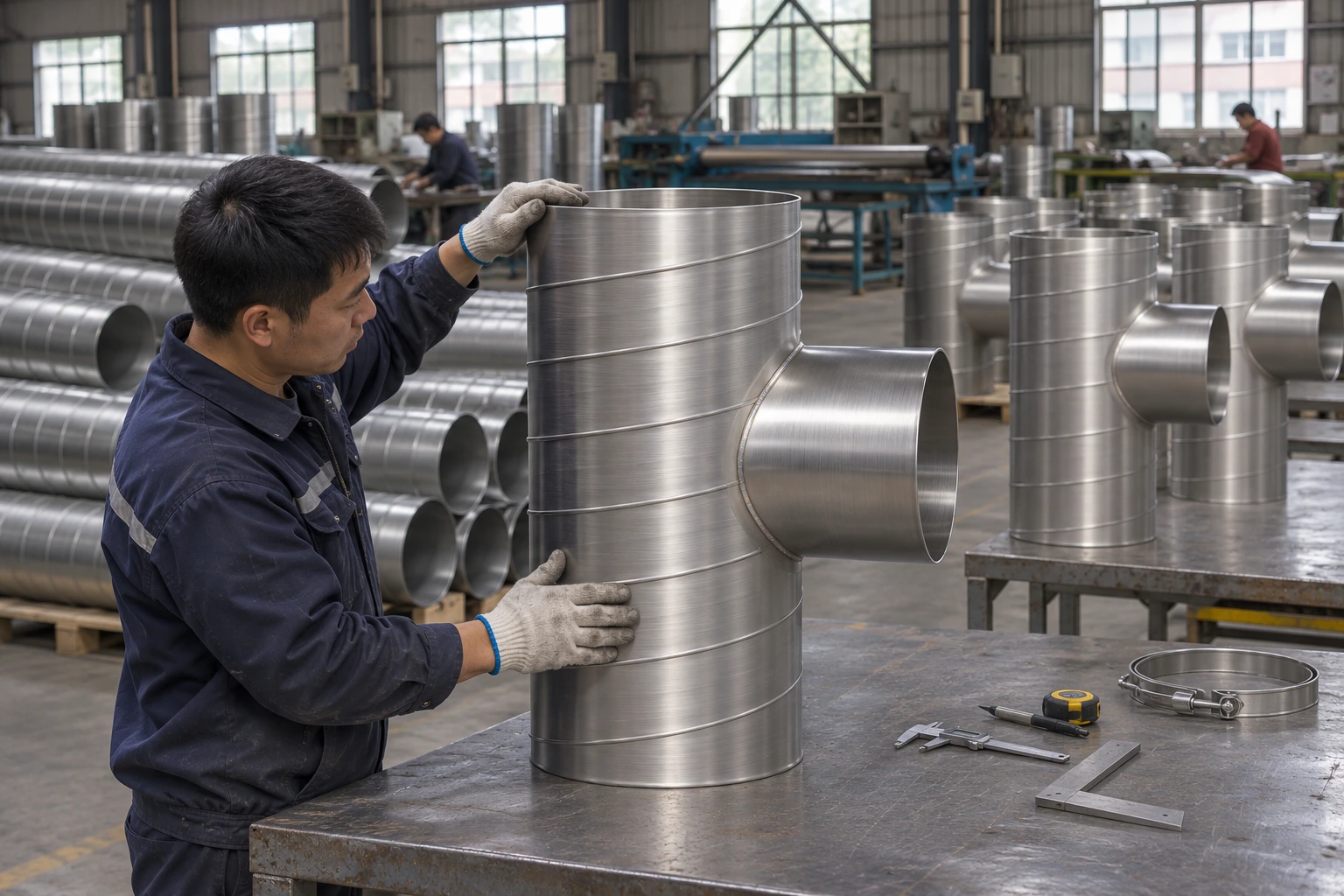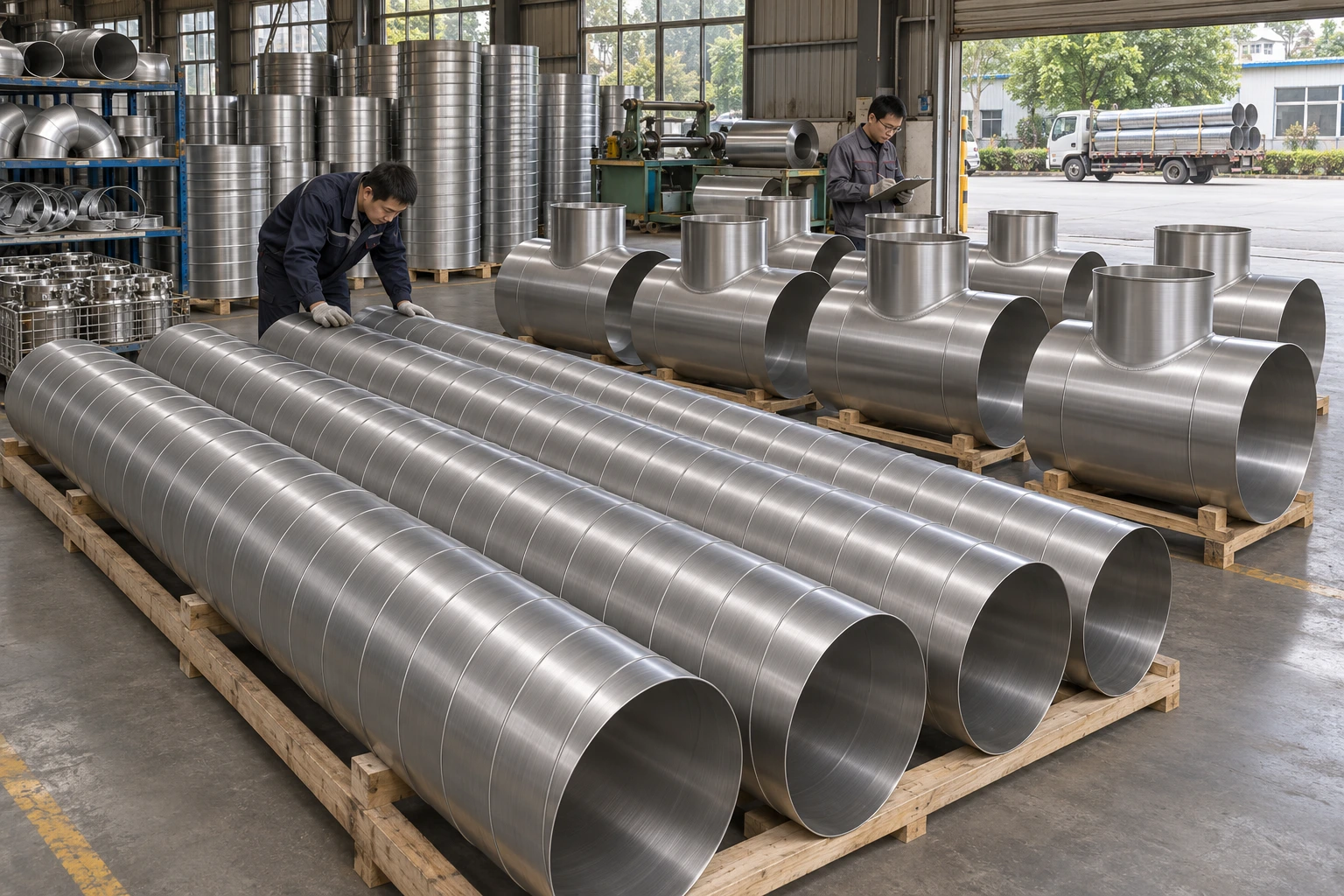

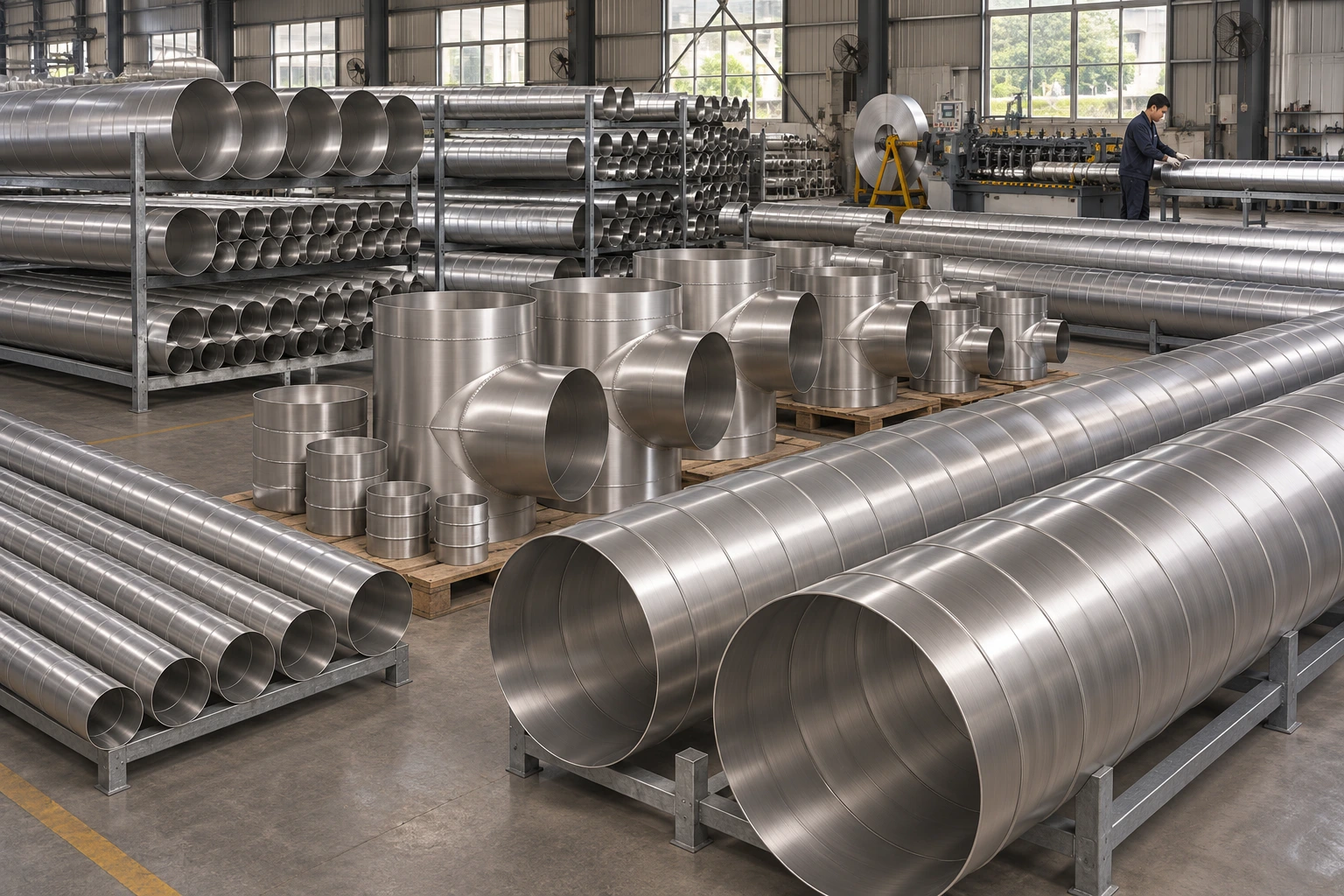
When adding an exhaust branch to a factory duct system in Yunfu, simply listing "stainless steel spiral duct tee" on a procurement order is insufficient—the fabricator will not know what connects to each of the three ends or which way the branch outlet should face. Even for tees of the same diameter, variations in the branch angle will affect the space available for subsequent elbows and suspension hardware. It is recommended to create a rough layout sketch—mapping the main duct, branch line, and on-site orientation—before transferring the dimensions to your procurement order.
Verify the diameters of all three ports.
Assign unique numbers to the main duct inlets, main duct outlets, and branch duct openings, documenting the corresponding pipe diameter and the component to which each connects. Note that scenarios such as having the same diameter at both ends of a main duct versus a reduction in diameter at a branch connection—or a change in the diameter of the main duct itself—represent distinct conditions for placing fabrication orders. If the blueprints use nominal sizes, and... When taking on-site measurements, record the outer diameter. Verify the dimensional reference points and clearly note the actual positions of pipe ends, spigots, or flanges. For retrofitting existing piping, provide photographs of the original pipe joints to ensure the correct fittings are selected—do not rely solely on a general site plan.
Specify branch pipe angles and orientations separately.
The angle between a branch pipe and the main duct must be specified separately from the branch’s orientation (i.e., its rotational position around the main duct’s axis). Use a side view to indicate whether the branch exits the main duct perpendicularly or at an angle, and include an end view to show whether the branch outlet is positioned facing upward, sideways, or downward. Clearly note the viewing direction relative to the main duct, and—ideally—include reference points such as the edges of beams, walls, or adjacent equipment. For rows of branch pipes, assign a unique number to each to distinguish between similar components (e.g., those exiting to the left versus the right).
Verify the positioning of tee fittings using on-site measurements.
Mark the distance from the center of the branch duct to a fixed reference point on the drawings. Verify the available straight-run length of the main duct, the space required for turns after the branch connection, and the clearance needed for assembling the joints. If the duct is located near valves, maintenance access areas, or cable trays, these obstructions must also be indicated. The branching method and layout should be confirmed by the project design team; for procurement purposes, the finalized angles, orientations, and dimensions can be compiled into a single attachment to facilitate verification by all parties.
Include interface details and identification numbers in the procurement schedule.
III. For each connection point, specify the interface type along with the corresponding straight pipe or fitting. Clearly define the material requirements for spiral straight pipes, tee bodies, and connecting hardware. When a price breakdown is required, list the tee body, associated connecting components, and quantities separately. If the orientation or dimensions are modified, update the drawing version and ensure the corresponding entry in the procurement list is updated simultaneously; this prevents discrepancies where one document is revised while another remains on an outdated version.
Check the orientation of components before installation.
During inspection, place each tee fitting next to its corresponding straight duct or accessory based on its assigned number. First, verify the three connection ports, then check the orientation of the branch port according to the perspective shown in the drawings. Conduct spot checks on joint assembly, the appearance of the duct ends, and any included accessories. Organize items by zone, ensuring sufficient clearance for handling and transport. For renovation projects, consult with Jinyou regarding ordering requirements—bring along sketches of duct diameters and branch orientations, photographs of existing joints, and the required quantities. If any existing ducts on-site have become deformed (e.g., flattened into an oval shape), please record the measurements taken from different directions.