
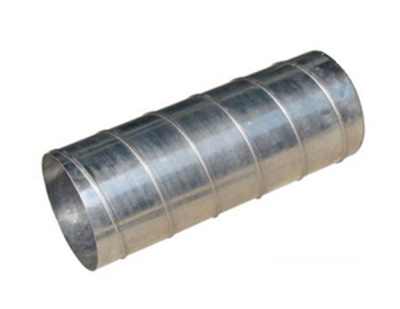
During the installation phase of ventilation projects in Jiangmen facilities, project delays often stem not from a total lack of straight ductwork, but rather from incomplete shipments—where straight ducts arrive, but the necessary connecting components are missing—or from dimensional mismatches caused by the use of a mix of old and new blueprints. When procuring spiral ducts, it is advisable to specify deliveries in detail: rather than just stating "how many meters by when," clarify "which area, which shipment batch, and which specific duct segments and accessories should arrive together."
Break down the procurement list by installation area.
Categorize straight ducts and fittings by workshop, floor, or system; specify the dimensions, quantity, and corresponding drawing version for each item. Do not aggregate quantities for similar duct diameters across different systems, as this complicates distribution upon arrival. Clearly mark any unconfirmed dimensions to prevent the supplier from proceeding with fabrication based on tentative data.
Every batch of straight ducts must be accompanied by the corresponding connection components.
Verify each item individually, including elbows, tees, reducers, connectors, flanges, fasteners, and other agreed-upon accessories. The procurement list should clearly state which components are to be provided by the fabricator and which are to be sourced by the installation contractor. In the case of phased deliveries, it is best to confirm all accessories required for a specific installation zone in the same batch; this helps prevent assembly delays on-site caused by the absence of even a single small component.
Prerequisites for establishing delivery timelines
When specifying a desired delivery date to a supplier, also clarify the timeline for drawing approval, material requirements, quantities, any special processing needs, and receiving conditions. Supply arrangements must be verified and confirmed by both parties; do not include "same-day shipment" in construction schedules if it has not been explicitly confirmed. For duct segments that connect to equipment, ensure the final dimensions at the equipment interface are obtained first.
Establish agreements on numbering conventions and packing lists in advance.
It is recommended to assign identification numbers to duct sections based on their specific system or zone, ensuring alignment across labels, drawings, and delivery manifests. Upon arrival, verify the quantity, specifications, connection orientation, and physical condition of the components; document any deformations or incorrect parts immediately. For duct segments that are not yet ready for installation, designate an appropriate storage area and implement protective measures to prevent them from being mixed up or damaged during subsequent handling.
Design changes must be communicated to the production and delivery teams
In the event of changes to site routing or equipment positioning, identify the affected duct sections and fittings—noting which have yet to be fabricated and which are already completed—before negotiating the necessary adjustments. Any changes must be documented in a new, traceable version of the bill of materials (BOM), with a clear indication of which previous versions are now obsolete. Relying solely on verbal instructions (e.g., "just change the dimensions") often leads to misinterpretation among procurement, fabrication, and installation teams.
Establish communication channels for potential replenishment or final-stage adjustments.
Before installation, establish agreements with the supplier regarding the format for submitting replacement parts, the process for confirming specifications, and the designated contact person for receiving shipments. Even for minor replacement parts, ensure there is clear documentation of dimensions and quantities; avoid relying on vague photos—such as those showing items that "look about the same"—as a form of confirmation. At the project closeout stage, compile a summary of remaining materials, missing items, and the status of documentation delivery to ensure the procurement process is fully closed out.
For inquiries regarding spiral ducts and ventilation accessories in the Jiangmen area—handled by Foshan Jinyou Environmental Protection Equipment Co., Ltd.—please provide a breakdown by zone, the latest version of the drawings, and the planned delivery schedule. Additionally, clarify the scope of responsibility for fabrication, transportation, unloading, and installation. Final pricing and lead times shall be based on the terms mutually agreed upon by both parties.